
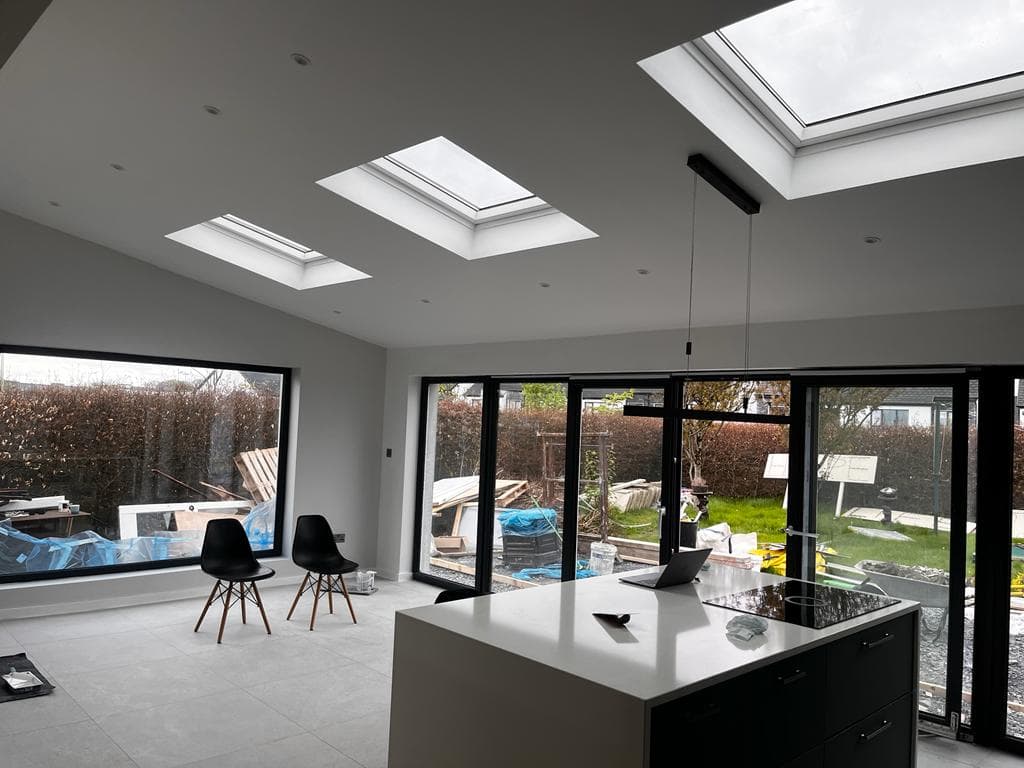
One of the most common comments we hear a few months after a window replacement is: "The house is warmer, but now it feels stuffy and the windows are wet in the morning." The windows are not faulty. The house has simply stopped leaking air, and the moisture and stale air that used to escape through gaps now need somewhere planned to go.
Why tighter windows change how a house breathes
Old windows and doors let a lot of air through worn seals and gaps. That was draughty and expensive to heat, but it also meant the house was being ventilated by accident. Modern windows are fitted and sealed far more tightly, so the accidental ventilation largely disappears.
A household produces a lot of moisture every day: cooking, showers, breathing, drying clothes indoors. If that moisture cannot leave, it settles on the coldest surfaces, which means glass, reveals and the corners of external walls. The result is condensation first and, if it continues, mould. Our guide to window condensation explains how to tell harmless room-side condensation from a failed sealed unit.
What Part F is about
In Ireland, ventilation of homes is covered by Part F of the Building Regulations and its Technical Guidance Document. The principle is straightforward: a dwelling needs adequate background ventilation, extract ventilation where moisture is produced (kitchens, bathrooms, utility rooms) and a way to purge rooms quickly when needed.
The exact requirements depend on the type of work. New builds are designed to meet current Part F as a whole, and the ventilation strategy is part of the design. For a window replacement in an existing house, the sensible approach is to keep or improve the background ventilation the old windows provided, rather than make the house airtight with nothing in its place. If you are unsure what applies to your project, your designer or building professional can confirm it, and we are happy to talk it through on a survey.
Option 1: trickle vents in the window frame
A trickle vent is a small adjustable slot, usually in the top of the frame, that allows a controlled amount of fresh air in even when the window is closed. For most replacement jobs this is the simplest solution:
- They are specified when the windows are ordered, so the cost is small compared with adding ventilation later.
- Fitted high up, incoming air mixes with room air before it reaches you, so it is rarely felt as a draught.
- They work best when kept open. The most common reason for condensation in new windows is trickle vents that have been closed in winter.
The limitation is that trickle vents only supply air. They do not extract moist air from kitchens and bathrooms, so working extractor fans are still needed.
Option 2: wall vents and extractor fans
Where windows do not suit a trickle vent, or a room needs more airflow, a vent through the wall is an alternative. Extractor fans in kitchens and bathrooms, ideally with a humidity sensor or run-on timer, remove moisture at source, which is more effective than ventilating the whole house to deal with a steamy shower.
A fan only works if air can get in to replace what it removes. In a very airtight room, a fan with no air supply struggles, which is another reason to keep trickle vents open.
Option 3: MVHR for very airtight homes
Mechanical ventilation with heat recovery (MVHR) uses a central unit to extract stale air from wet rooms and supply fresh air to living areas and bedrooms, passing the outgoing heat to the incoming air. It suits very airtight, high-performance homes, particularly new builds and deep retrofits, because it ventilates continuously without losing much heat. It needs planning at design stage, ducting and a filter-change routine, so it is rarely a quick add-on to a window replacement. See our energy-efficient renovation guide for how ventilation fits into a wider upgrade.
Practical habits that help
- Leave trickle vents open all year, including winter.
- Run extractor fans during and for a while after cooking and showering.
- Avoid drying washing on radiators in closed rooms.
- Keep wardrobes slightly away from cold external walls.
- Use a cheap hygrometer. Indoor humidity that sits well above 60% regularly suggests more ventilation is needed.
Specifying ventilation when you order windows
The best time to decide is before the order goes in. When we survey a Galway home we look at how each room is used, whether there are working extractors, how airtight the house already is, and whether the frames should include trickle vents. Adding them to the order costs far less than cutting vents in later. If you are comparing frame types, our guide to uPVC, aluminium and aluclad windows covers the options.
If you are planning new windows or doors in Galway City or County, see our windows and doors service, request a quote, or get in touch and we will advise on the right ventilation for your home.
Planning a Similar Project in Galway?
KRB Construction & Windows can help with windows, doors, renovations, attic conversions and practical construction advice for your home.